

Hip
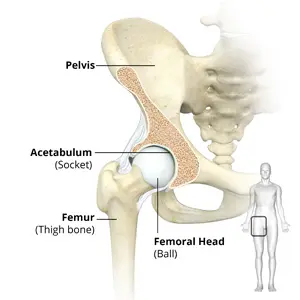
The hip joint is the largest weight-bearing joint in the human body. It is also referred to as a ball and socket joint and is surrounded by muscles, ligaments, and tendons. The thigh bone or femur and the pelvis join to form the hip joint.
Learn More About Hip Anatomy ›


Hip Arthroscopy
Hip arthroscopy, also referred to as keyhole or minimally invasive surgery, is a surgical procedure in which an arthroscope is inserted into your hip joint to check for any damage
View More
Hip Labral Repair
Hip labral repair is a surgical procedure to treat hip labral tears.
View More
Hip Surgery
Hip surgery is a surgical procedure for the treatment of a hip injury or hip condition.
View More
Hip Reconstruction
Hip reconstruction is a surgery to repair or replace a damaged hip joint that causes pain and limits your movement.
View More
Acetabuloplasty
An acetabuloplasty is a surgical procedure employed for the correction of a condition known as pincer impingement.
View More
Hip Preservation Surgery
Hip preservation surgery focuses on treating hip problems at an early stage to protect the natural joint and delay or prevent the need for hip replacement.
View More
Hip Labral Reconstruction
Hip labral reconstruction is a surgery that involves the use of a graft to replace the damaged portion of a hip labrum.
View More
Proximal Hamstring Repair
Proximal hamstring repair is a surgical procedure performed to treat a severe tear or complete rupture of the hamstring tendons where they attach
View More
Iliopsoas Tendon Lengthening
Iliopsoas tendon lengthening is a procedure that involves the excision or cutting of the iliopsoas tendon in the hip to reduce pain and improve range of motion.
View More
Surgical Release of Iliopsoas Tendon
Surgical release of the iliopsoas tendon is a procedure that involves the excision or cutting of the iliopsoas tendon in the hip to reduce pain and improve range of motion.
View More
Gluteus Maximus Transfer
Gluteus maximus transfer, also referred to as gluteus maximus flap transfer (GMT), is a surgical technique
View More
Endoscopic Proximal Hamstring Repair
Endoscopic proximal hamstring repair is a minimally invasive surgery performed using an endoscope - a thin, long, flexible tube
View More
Hip Cartilage Restoration
Hip cartilage restoration is a surgical technique to repair damaged articular cartilage in the hip joint by stimulating new growth of cartilage
View More
Nonsurgical Hip Treatments
The hip is a ball-and-socket joint that connects the thigh bone to the pelvic bone.
View More
Arthroscopic Gluteus Medius Tendon Repair
Arthroscopic gluteus medius tendon repair is a minimally invasive surgical procedure employed for the treatment of a gluteus medius tendon tear
View More
Core Decompression for Avascular Necrosis of the Hip
Core decompression is a joint-preserving surgical procedure used to treat early stages of Avascular Necrosis (AVN) of the hip.
View More
Hip Labral Tear
A hip labral tear is an injury to the labrum, the cartilage that surrounds the outside rim of your hip joint socket.
View More
Hip Ligament Injuries
Injuries to the hip ligaments are commonly called a hip sprain and can range from minor tears of the ligaments to more serious injuries involving the hip muscles, tendons or bone.
View More
Hip Pain
Hip pain, one of the common complaints, may not always be felt precisely over the hip joint rather in and around the hip joint.
View More
Hip Injury
The hip is a vital joint that supports body weight and enables smooth movement during everyday activities such as walking, running, and bending.
View More
Hamstring Injuries
The hamstring is a group of three muscles that run along the back of the thigh from the hip to the knee.
View More
Hip Instability
Injury or damage to these structures can lead to a condition called hip instability when the joint becomes unstable.
View More
Hip Bursitis
Hip bursitis is a painful condition caused by the inflammation of a bursa in the hip.
View More
Hip Tendonitis
Hip tendonitis is a condition associated with degeneration of the hip tendons.
View More
Hip Dislocation
Hip dislocation occurs when the head of the femur moves out of the socket. The femoral head can dislocate either backward (posterior dislocation) or forward (anterior dislocation).
View More
Gluteus Medius Tear
A gluteus medius tear is the partial or complete rupture of the gluteus medius muscle due to severe muscle strain.
View More
Chondral Lesions or Injuries of the Hip
Chondral injuries can result from various hip conditions such as labral tears, loose bodies, posterior dislocation, slipped capital femoral epiphysis (SCFE), dysplasia, osteonecrosis,
View More
Avascular Necrosis
Avascular necrosis, also called osteonecrosis, is a condition in which bone death occurs because of inadequate blood supply to it.
View More
Stress Fractures of the Hip
Stress fractures of the hip are a break in the upper part of the thigh bone (femur) that fits into the socket of the hip joint.
View More
Femoroacetabular Impingement
Femoroacetabular impingement (FAI) is a condition characterized by excessive friction in the hip joint from the presence of bony irregularities.
View More
Hip Synovitis
Hip synovitis, also called transient hip synovitis or toxic synovitis, is a condition characterized by inflammation of the synovial tissues that surround the hip joint.
View More
Ischial Bursitis
Bursae are fluid-filled sacs present between the tendons and bones to help facilitate smooth movement.
View More
Trochanteric Bursitis
Trochanteric bursitis is a painful condition caused by inflammation of the trochanteric bursa, a fluid-filled sac that overlies the greater trochanter (bony prominence at the outer side of the hip).
View More
Iliopsoas Tendonitis
Iliopsoas tendonitis also referred to as snapping hip syndrome, is an inflammation of the iliopsoas tendon or the surrounding area.
View More
Iliopsoas Impingement
Iliopsoas impingement also known as internal snapping hip syndrome is a condition characterized by inflammation and pain in the iliopsoas muscles resulting in abnormal movement of the hip.
View More
Hip Osteonecrosis
Hip osteonecrosis occurs due to disruption of the blood supply to the highest part of the thigh bone (femoral head).
View More
Hip Retroversion
Hip retroversion also known as femoral retroversion is a rotational deformity in which the hip is rotated outward in relation to the knee.
View More
Subspine Impingement
Subspine impingement, also known as anterior inferior iliac spine impingement, is a hip condition characterized by excessive friction caused by bony
View More
Loose Bodies
Loose bodies are small fragments of bone or cartilage that become detached and float within the hip joint.
View More
Heterotopic ossification
Heterotopic ossification is a condition in which abnormal bone forms in soft tissues around the hip joint, such as muscles and ligaments.
View More